
The best review I ever got was written by a ten-year-old. He wrote that his suite was bigger than his house.
I kept that comment card for years.
Not because it was flattering. Because it was accurate. That kid wasn’t reviewing a hotel. He was reporting an outcome. His family didn’t book the Albert at Bay because it had the best lobby in Ottawa. They booked it because they needed space — real space, apartment space — and we had it. Two bathrooms. A full kitchen. Separate bedrooms. 650 to 1,200 square feet of what felt, to a ten-year-old from a modest house, like a palace.
That’s not a hotel story. That’s an outcomes story.
And it’s the story the entire hotel industry needs to understand right now — before AI makes the point for them, the hard way.
AI Isn’t a Better Search Engine
Most hotel operators have a misconception about AI: they think it’s a smarter version of Google. Better at finding things. More convenient than scrolling through Expedia.
It’s not.
AI is a decision proxy. It acts on behalf of the guest. It doesn’t browse — it solves. It takes a set of requirements, a context, a use case, and finds the best outcome match. Not the best hotel. The best outcome.
Brand loyalty survives when a guest declares it. What doesn’t survive is the assumption that familiarity alone will win the match. An AI working without a stated brand preference doesn’t default to the recognizable name — it defaults to the best outcome fit. Star ratings don’t survive that either. What does is a clear, provable record of delivering a specific outcome to a specific type of guest.
The Comment Card Nobody Else Used
When I took over management of the Albert at Bay Suite Hotel in Ottawa, the standard hotel comment card was a 1-to-10 scale. Rate the room. Rate the service. Rate the amenities.
I thought about it for about five minutes and threw the scale out.
One person’s 6 is another person’s 7. What does a 7 even mean? That you liked it but not that much? That you’d come back but wouldn’t tell your friends? Numbers without context are noise.
I replaced the scale with four options: Failed to meet expectations. Met expectations. Exceeded expectations. Not applicable.
That’s it. Because at the end of the day, that’s all that actually matters. Not whether a guest would rate the bathroom a 7 or an 8. Whether we delivered what they came for.
If you don’t keep score, how do you know you’re winning?
The comment card was the scoreboard. And the only score that counts is whether the guest got what they expected — or better.
When a card came back “failed to meet expectations,” we followed up with the guest. We tracked patterns. Are bathrooms a recurring problem? Is it parking? Wifi? The fix matters less than finding the trend. One complaint is an incident. Three complaints is a system failure.
That feedback loop — expectation set, outcome measured, gap identified, process fixed — is exactly what AI is doing right now with every review your hotel has ever received. Except AI never forgets, never loses the card, and cross-references it against ten thousand similar guests.
Most hotels are good products. They are bad data objects.
The Clock
One afternoon I was in the lobby chatting with a guest. Casual conversation. He mentioned that he’d used the exercise room that morning — great space, he said — but it could really use a clock.
I got in my car and bought a clock that day.
No committee. No facilities request form. No “we’ll look into that for next quarter.” A guest identified a gap between his expectations and his experience, and I closed it before dinner.
That’s the independent hotel’s structural advantage — and AI is going to make it more valuable, not less. Reviews don’t just record what guests thought. They record when things changed. An operator who responds to feedback in days leaves a different data trail than one who responds in quarters. AI will eventually see that pattern too.
Chains have infrastructure. Independents have speed. In an outcomes economy, speed of response to expectation gaps is a competitive moat.
What Ten Years of Reviews Actually Told Us
The Albert at Bay closed in 2020 after 35 years. But before it did, it spent over a decade ranked in the top three to five hotels in Ottawa on TripAdvisor. We worked for those reviews. We asked every guest. We trained staff to ask.
I didn’t understand at the time that we were building something more valuable than a ranking. We were building a use-case library.
Read the reviews and the pattern is unmistakable. Nobody described a hotel. They described a problem that got solved.
A family with food allergies: “We had a full kitchen, which makes life a lot easier.” A wheelchair user: “Inside passage to the adjoining convenience store, which made it possible to go pick up food without having to go outside in the rain or snow.” A road trip family: “It was so nice to eat a homemade breakfast after eating on the road for a couple of days.” An extended-stay guest with two small children: “Definitely doesn’t feel like staying in a stuffy hotel.”
That’s not marketing copy. That’s outcome documentation. A salesperson who reads “I closed the bedroom door and had my client meeting in the living room” knows exactly what they’re buying. A family traveling with a kid who has food allergies knows exactly what they’re buying.
An AI agent knows too.
The hotel with ten years of reviews describing specific outcomes for specific use cases is a clear, readable data object. The hotel with five hundred reviews that say “great location, friendly staff” is a blur.
Are You a Good Product That AI Can’t See?
Here’s the question every independent operator needs to answer right now: if an AI agent were trying to match a specific guest to a specific hotel based on your entire review history — could it do it?
Not “would you rank well.” Could the AI see you clearly enough to make a confident match?
If your reviews are generic, the answer is no. And a decision proxy that can’t make a confident match doesn’t take a chance on you. It moves to the next option.
So here’s what I’d do today if I were still running the Albert at Bay.
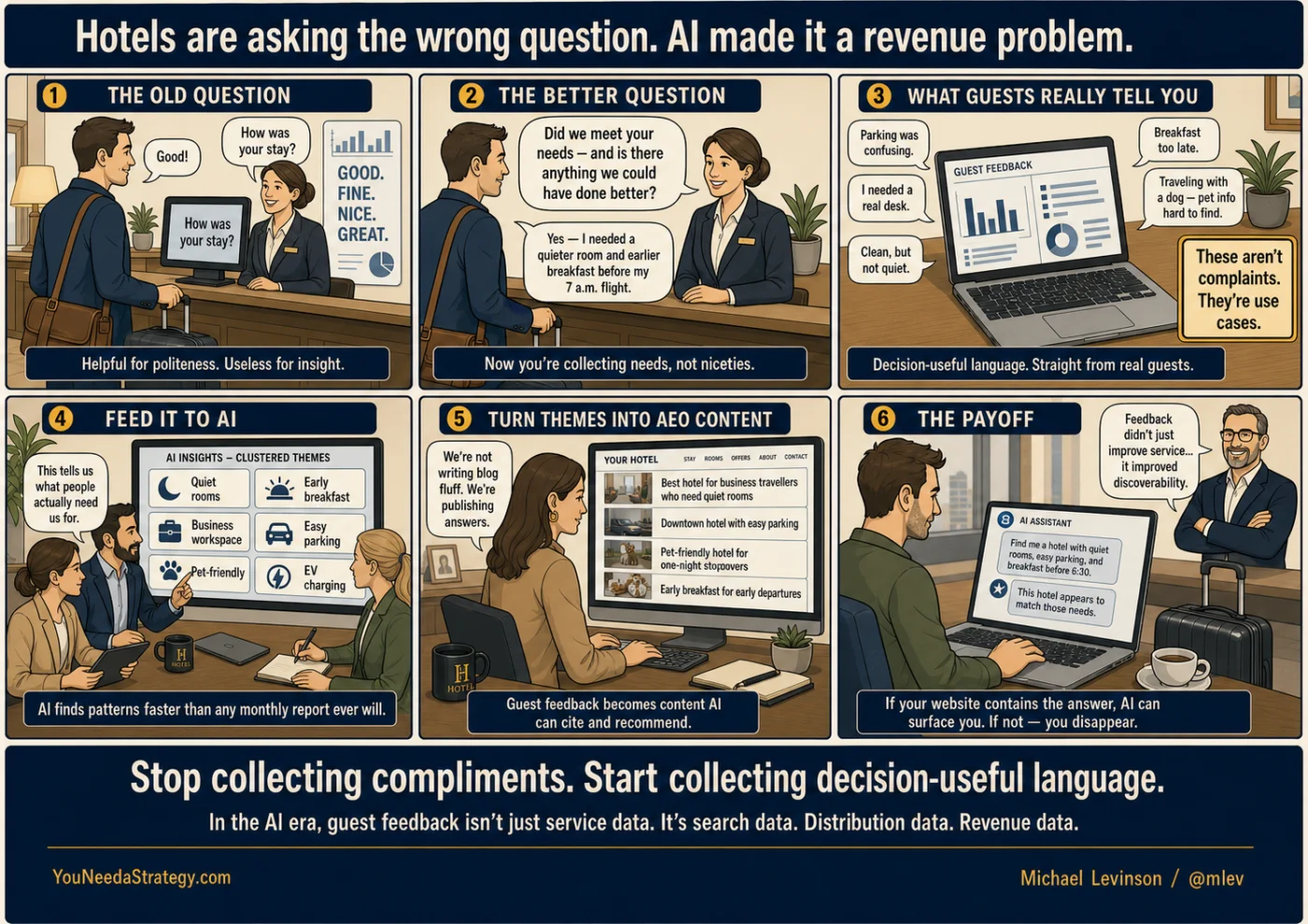
First: feed every review you have into AI and ask it to find the themes. Not the ratings — the use cases. What problems did guests come in with? What outcomes did they leave with? You’ll find patterns you’ve never consciously noticed. That’s your product, described by the people who bought it.
Second: build a page called “Who Stays Here and Why.” Not testimonials. Real outcomes organized by guest type. The couple who came for the restaurant and rebooked for the anniversary. The family who needed two bedrooms and a late checkout and got both without asking. The business traveler who switched from the Marriott because your front desk remembered his name. Each one is a use case an AI agent can match against. Your hotel becomes a data object an agent can reason about — not just a star rating and a price.
Third: change one question your staff asks every departing guest. Not “how was your stay?”
“Did we meet your needs — and is there anything we could have done better?”
That question does something “how was your stay” never will. It signals that you’re obsessed with the gap between expectation and outcome. It gets specific answers instead of polite ones. And it keeps the feedback loop alive — the same loop I was running off handwritten comment cards in 1985.
The hotels that survive AI won’t necessarily be the most luxurious, the best located, or the most aggressively priced.
They’ll be the ones that understood, long before AI showed up, that they weren’t selling rooms.
They were selling outcomes. And they kept score.
Download the free 12-point AI Visibility Checklist for Hotel Operators →
If you sit on a hotel board and the question “could an AI see us clearly enough to match us to a specific guest” doesn’t have an answer yet, that question belongs at your next meeting. An operator who’s been on both sides of this →