
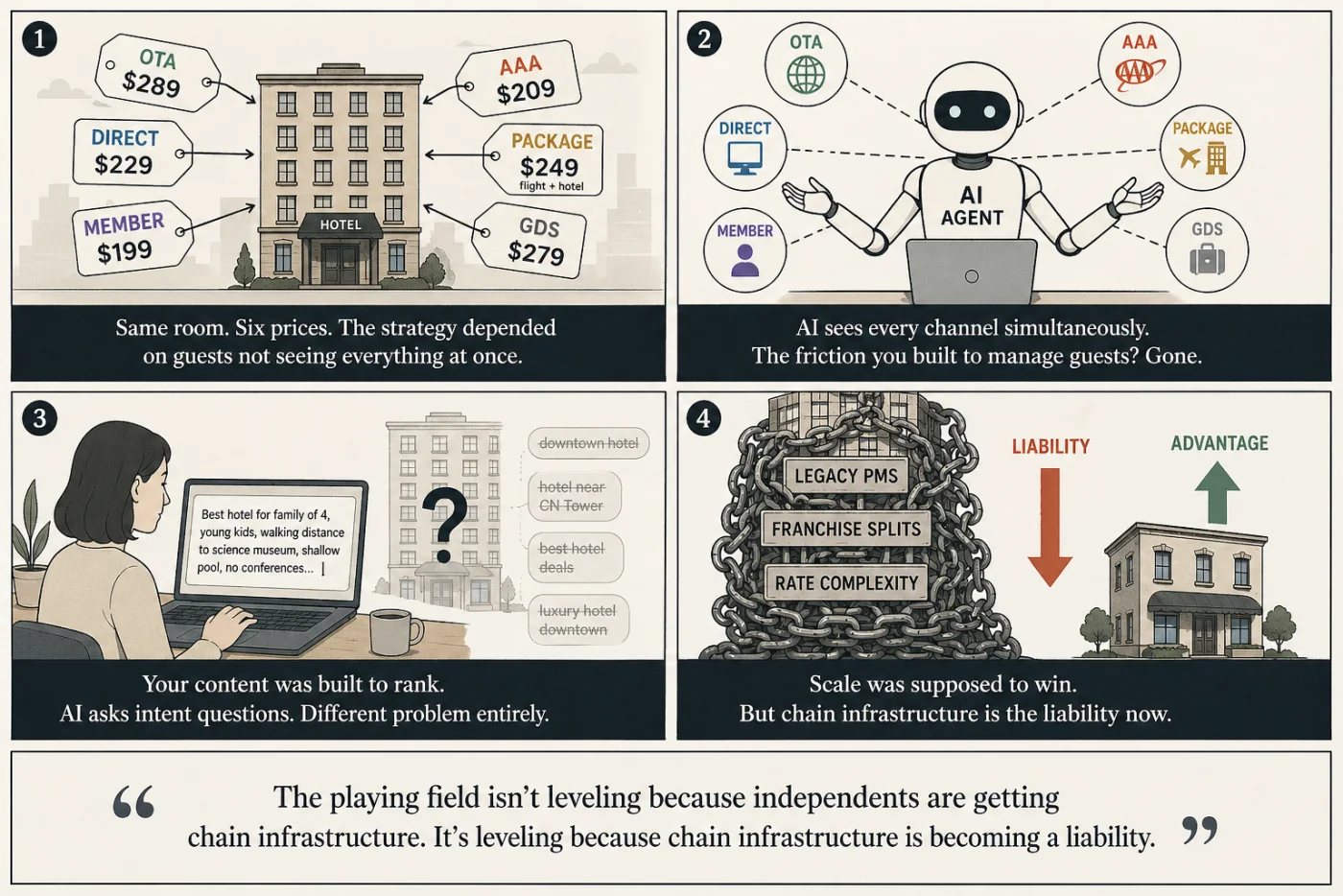
Somewhere in a hotel revenue manager’s workday, the same room gets priced six different ways.
The OTA rate. The corporate rate. The direct rate. The member rate. The AAA rate. The rate buried in a package that technically includes breakfast but is really just a way to obscure the room component. Different cancellation terms on each. Different fee disclosures. Sometimes a different room name — the “Superior King” on OTAs, the “Deluxe King” on direct, the same four walls and the same view of the parking garage.
This isn’t sloppiness. This is the job. Revenue management built this architecture deliberately, over decades, because it worked. The strategy assumed something that was true for a very long time: guests couldn’t compare everything at once. The friction was the feature.
AI just removed the friction.
When an AI booking agent searches for a hotel room, it doesn’t open one tab and then another and then another. It queries simultaneously. It sees every channel, every rate, every term, every disclosure in the same moment. The deliberate complexity hotels built to manage guest behavior across channels now reads to an AI as incoherence — or worse, as a signal that the property can’t be trusted to quote a clean price.
The revenue management problem hotels are about to have isn’t a technology problem. It’s a strategy problem. The strategy was built for a world where information asymmetry was structural. Where guests did the work of assembling comparisons, and the friction of that work protected the complexity. That world is over. The strategy built on top of it doesn’t retire quietly — it actively misfires.
You don’t fix this by cleaning your PMS. You fix it by reconsidering a pricing philosophy that assumed your customer would never have perfect information.
Some hotels won’t want to have that conversation, because the answer requires dismantling a revenue architecture that took years to build. But the conversation is coming whether they want it or not.
That’s one problem. Here’s the second one, and it’s different in kind.
Revenue management complexity is something hotels built intentionally. The contextual content gap is something they stumbled into — by building their content infrastructure for a technology that’s already being replaced.
Hotel content was built for keyword search. Someone types “downtown Toronto hotel.” The algorithm matches keywords, weighs domain authority and reviews, and surfaces results. Hotels have spent years and considerable budget optimizing for that interaction. Metadata. Schema markup. SEO-tuned descriptions. “Located in the heart of downtown, steps from…” — you’ve read it a thousand times, because it was written to rank, not to inform.
AI doesn’t search keywords. AI answers intent.
“Best hotel for a family of four with young kids who want to walk to a science museum, need a pool with a shallow end, and don’t want to deal with conference groups taking over the lobby.”
That’s not a keyword query. It’s a conversation. And it requires a completely different kind of answer — one that draws on specific, contextual, experiential knowledge about what a property is actually like. Not what it claims to be in the metadata. What it’s actually like at 4pm on a Tuesday when the kids are tired and someone needs a snack.
Most hotels have no content infrastructure built to answer that question. The content that exists was written to be found, not to be understood. There’s a meaningful difference, and AI exposes it immediately.
Here’s where it gets interesting for the chains.
The conventional wisdom going into the AI era was that scale would win. Marriott and Hilton have the data, the loyalty programs, the brand recognition, the infrastructure. Independents would scramble to access chain-level tools. The playing field might level a little, but the structural advantages of scale would hold.
The conventional wisdom has it backwards.
Chains don’t just have more hotels. They have more of both problems. More rate complexity across more channels, negotiated by more revenue managers under more ownership structures, with more franchise agreements creating more commercial truth inconsistency. An AI agent trying to quote a clean, trustworthy rate for a Marriott property in a managed franchise location is navigating a maze that Marriott itself didn’t fully design.
And the contextual content problem scales badly. An independent property — one hotel, one team, one set of guests they actually know — can build the contextual knowledge base that AI needs. It’s work, but it’s achievable. A chain running 3,000 properties across four continents and a dozen brand tiers needs to rebuild that content infrastructure at a scale that makes the original OTA integration look simple.
Marriott and Hilton know this. Their 10-K filings are already flagging AI intermediaries as a threat to loyalty, booking flows, and distribution costs. They’re not warning investors because they lack tools. They’re warning investors because their systems are too fragmented to feed AI cleanly, and they don’t have an obvious path to fix that without disrupting the franchise model that generates most of their revenue.
The independent hotel that knows its guests, quotes a consistent rate, and can tell an AI agent exactly why it’s the right choice for a family of four with young kids — that property has a structural advantage in AI-mediated booking that scale cannot easily replicate.
The playing field isn’t leveling because independents are getting chain infrastructure. It’s leveling because chain infrastructure is becoming a liability.
This is the part of the AI distribution conversation that the industry hasn’t fully absorbed yet. The discussion is almost entirely about tools — what AI platform to use, how to optimize schema markup, whether to invest in an AI booking agent integration. Tools matter. But tools applied to a broken commercial architecture just automate the brokenness faster.
The hotels that will navigate this well aren’t the ones that adopt AI earliest. They’re the ones that arrive at AI with the simplest, most consistent, most trustworthy commercial truth — clean rates, coherent content, a clear sense of what they are and who they’re for.
Which, come to think of it, is exactly what good operators have always built.
The tools are new. The fundamentals aren’t.
Download the free 12-point AI Visibility Checklist for Hotel Operators →
For boards: this isn’t a marketing decision. The commercial-architecture choices that determine whether your property is legible to AI sit at the governance level. A director with operator-level judgment → is what most hotel boards are missing right now.