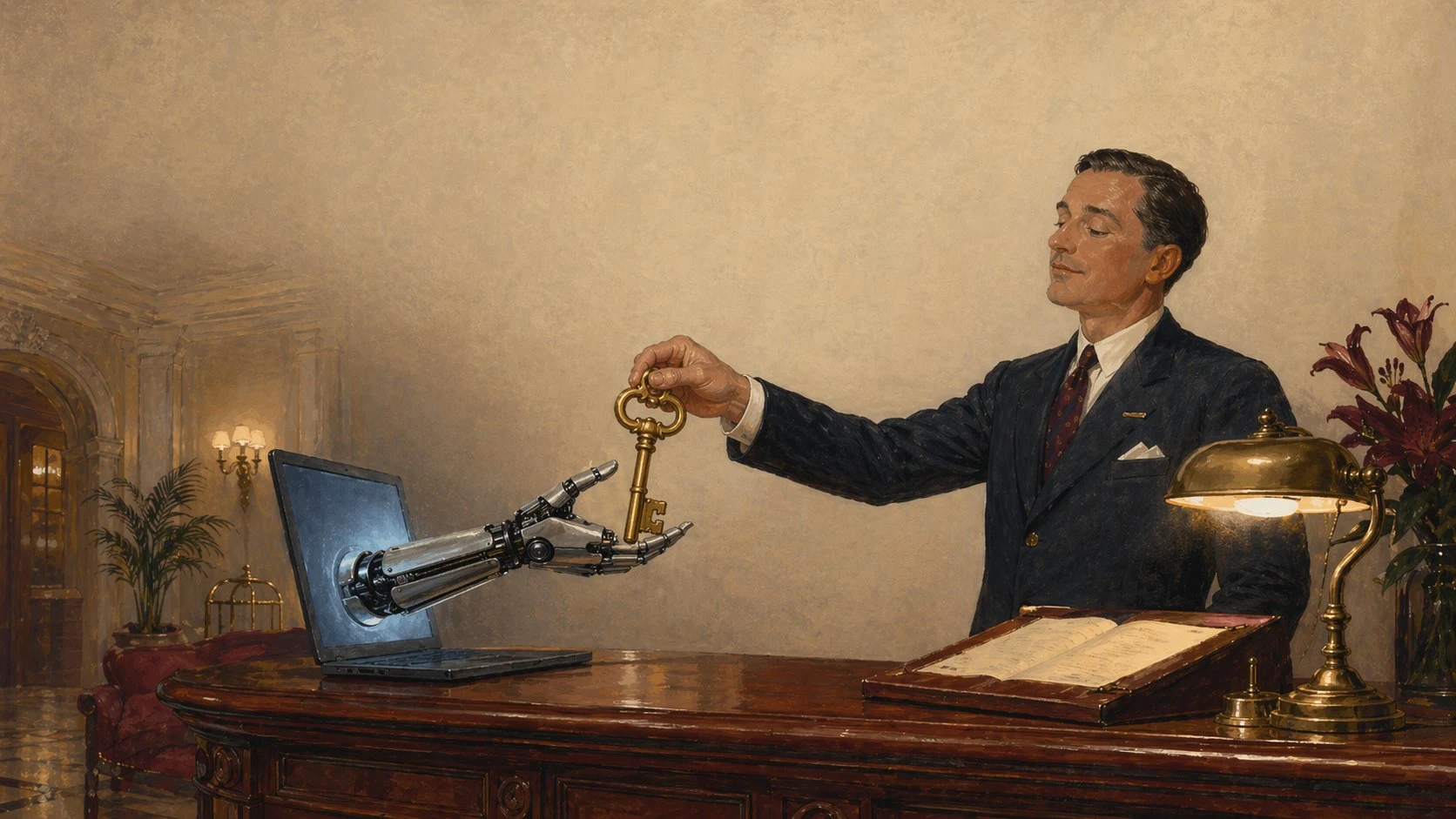
In 1997 I walked into a hotel lobby to pitch BookDirect. I spent ten minutes explaining to the owner that the internet was going to change how people booked rooms. He listened politely, the way you listen to someone describing their dream from the night before. And then he said the seven words that defined the next twenty-five years of hotel distribution.
“I don’t understand any of this. Go talk to my sales team.”
Reader, I went and talked to his sales team.
That was the first wrong turn an entire industry made, committed in a lobby in 1997 before anyone knew they were making it. The most strategic question a hotel would face in its lifetime… handed, in real time, to the people paid to fill rooms next Tuesday.
What I was trying to sell him
BookDirect was an Internet Booking Engine. The job of an IBE is simple: a button on the hotel’s own website, next to the reservation form. Guest clicks it, enters dates, gets a room. The hotel sets the rate. The hotel owns the guest. No commission. The booking lands in the hotel’s property management system the same way a walk-in does.
That was the whole pitch. Keep the guest. Keep the margin.
Most owners in 1997 listened to that pitch, installed the engine, and then two months later signed an inventory contract with Expedia anyway. “Let’s try this new thing too.” That “too” is the whole story.
What actually went wrong
Strategic questions in business wear the uniform of whatever department currently handles them. Distribution at a hotel wore a marketing uniform. So marketing handled it. By the time the uniform came off, the OTA contract was signed and the customer relationship had quietly moved to a Seattle office building.
Nobody did anything wrong at the level it was done. Sales people optimized for bookings. Marketing people optimized for reach. Both hit their numbers. The hotel’s long-term ability to acquire a guest without paying a toll to someone else… that wasn’t anybody’s KPI.
This is how governance failures actually happen. Not with a villain in a bow tie. With a P&L that looks fine and a department that’s hitting quota.
The owner in that 1997 lobby wasn’t lazy. He wasn’t shortsighted. He made the most natural mistake an owner can make: he assumed the guy showing up with a pitch about booking channels was selling him a sales tool. So he routed me to sales. His board, if he had one, almost certainly ratified the OTA contract a few months later as a marketing decision that had already been made below them. Nobody in the building was wrong. The building was wrong.
The accounting problem that kept the failure invisible
Even an owner who was paying attention couldn’t see what was happening, because the books didn’t show it.
Hotels don’t have a Cost of Goods Sold line. No cost of guest acquisition. Every other industry I can think of tracks what revenue costs. Restaurants know their food cost. Retailers know their margin on every SKU. A dry cleaner can tell you to the cent what a hanger costs. Hotels? Revenue just arrives on the books, cheerful and unquestioned, like it came in a gift basket.
So when the OTA contract started delivering rooms at 75% of rack rate, the 25% commission didn’t appear on the P&L as an expense. It appeared as lower revenue. The board saw RevPAR. RevPAR looked fine. Nobody was looking at the line that would have told them what was really happening, because the line didn’t exist.
Decades later, someone finally built it. That was me.
The report that almost missed it
We spent a month building the new “cost of guest acquisition” line into the monthly reporting. New categories. New allocation logic. Proper source tracking. The first month it ran, my director of sales walked into my office and said, “Expedia is 30% of our occupancy this month.”
I pulled up the report. The Expedia line looked like a rounding error.
So I asked him: “If Expedia is 30% of our rooms, why is the cost of acquisition almost nothing?”
He said, “They’re net rates.”
Two words. That was the whole answer.
The OTAs had already evolved past the commission model I’d been tracking. They were buying rooms from us at a net rate and marking them up to the guest. Their profit never showed up on my books as a commission. It showed up as lower revenue per room. Buried in RevPAR. Invisible on the P&L.
A month of work to build the report. The OTAs had already made sure the biggest cost on my P&L wouldn’t appear on it. The owners and directors who didn’t have any report at all didn’t stand a chance.
The diagnosis
Three failures compounded. No COGS. No cost of guest acquisition. No board-level question about channel ownership. Any one of them, by itself, was probably survivable. All three together was how an industry got captured.
This isn’t an OTAs-are-villains story. The OTAs built a great product and did their job. Genuinely admirable work, the way a pickpocket’s technique can be admirable from six feet away. The point isn’t that the OTAs were sharper. It’s that the hotels were governed like the question they were facing didn’t exist.
AI is about to take the customer again
Here’s why I’m writing this now, in 2026, instead of making it a memoir chapter.
The AI assistants answering “where should I stay in Toronto next weekend?” are becoming the new recommendation layer. ChatGPT, Claude, Perplexity, Gemini. The features now baked into Google and Bing. The next three your guests will use before booking. They are in the process of doing to hotel discovery what Expedia did to hotel booking. If you don’t show up in their answers, you aren’t in the consideration set. Doesn’t matter how good your hotel is.
And I can already tell you what most hotels are going to do.
They’ll treat AI like marketing. They’ll hire an AI specialist who was a social media specialist last year and will be a web3 specialist next year. Somebody will run a $15,000 pilot with a chatbot vendor nobody reads the report on. And the board will not touch it. Even though they already know the OTA story. Even though they have read the case studies. Even though they could recite the whole thing back to you because they lived it. Because it looks like marketing.
It is not marketing. It has never been marketing. It’s the same strategic question, showing up in a new channel, wearing a different uniform.
Who owns the customer relationship when the discovery happens inside an AI conversation? Who sets the rules? Who gets paid when you get booked? What’s the long-run economic structure of the channel? Those aren’t questions for the marketing department. They’re questions for the owner and the board. If they aren’t asked there, they’ll be answered by someone else, somewhere else, in a way that does not favor the hotel.
Questions your board could be asking instead
I was once in a meeting with restaurant owners who spent the better part of an hour arguing whether cole slaw was a side dish or a garnish. No resolution. I have never forgotten it. It was the clearest demonstration I’ve ever seen of how organizations use decisions to avoid decisions… the long debate about the small question that protects everyone from the short debate about the big one.
(Out of curiosity, I asked an AI the same question recently. Four seconds: side dish, obviously, here are seven reasons why. The owners spent an hour.)
Your board has a cole slaw meeting happening right now. The cole slaw is AI.
Here are the questions you could be asking instead:
- Who owns the customer relationship at the end of each booking channel we use?
- What’s our dependence curve on any single acquisition channel?
- What decision rights does this board actually have over distribution strategy, and what’s been quietly delegated to a department?
- If AI becomes the discovery layer, who controls our appearance in it, and what will they charge us for that?
- What’s our cost of guest acquisition by channel, and is it surfaced in the board reporting package in a way that would let the board see a second OTA moment while it’s happening?
None of these are hard questions. They are, in fact, obvious questions. The OTA story looks obvious too, in retrospect. Obvious questions, asked at the wrong level, do not protect anyone.
The pattern is the point
Every industry going through channel disruption makes this same mistake. The ones that survive it stop treating distribution as a marketing function and start treating it as a strategic one with board-level attention. The ones that don’t… you can read about them in the case studies.
Hotels have one more chance to do this differently. Most won’t. The rest of you reading this from adjacent industries… travel, healthcare, legal services, financial advice, anything where a recommendation layer is about to get replaced by an AI… you’ve been warned in writing. The archive is searchable.
Free 12-point AI readiness checklist for independent hoteliers →