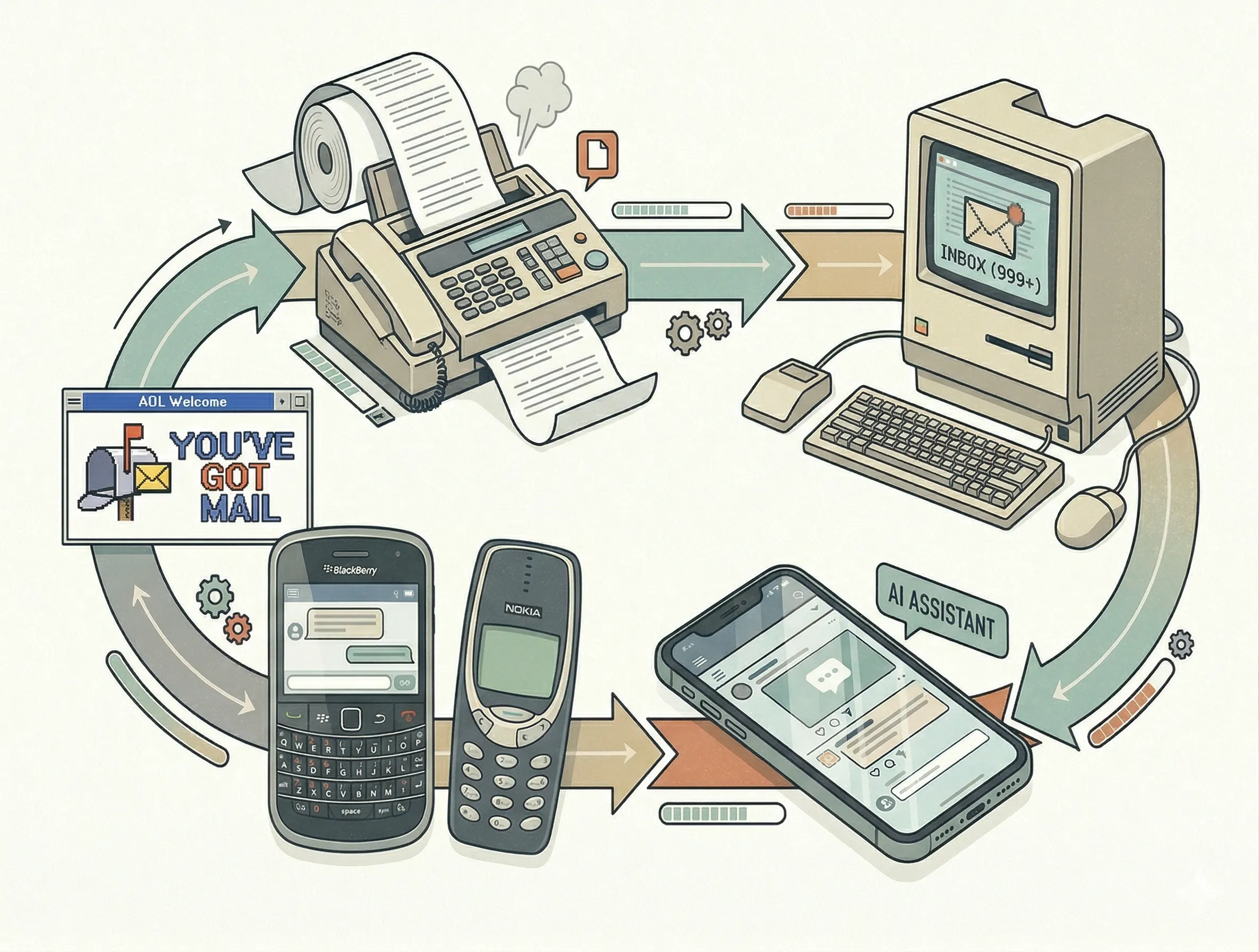
It was sometime in the mid-eighties. Dinner at my parents’ house, one of those evenings that stretched into a second bottle of wine and wandered wherever it wanted to go. My father’s friend Chuck — a lawyer, sharp guy, the kind who’d seen enough to have a strong opinion about everything — was frustrated.
The fax machine, he said, had broken something.
Before the fax, a contract went out by courier. The other side received it in a day or two, thought about it, and got back to you. There was a natural rhythm to the work. Time to think. Time to breathe. Now? The fax arrived and people expected a response that afternoon. The pressure didn’t let up. The pace just… permanently shifted.
Chuck didn’t know it at the time, but he was living inside a pattern that had been named fifteen years earlier — and that we’re about to repeat, at a scale none of us are fully prepared for.
What Alvin Toffler saw coming
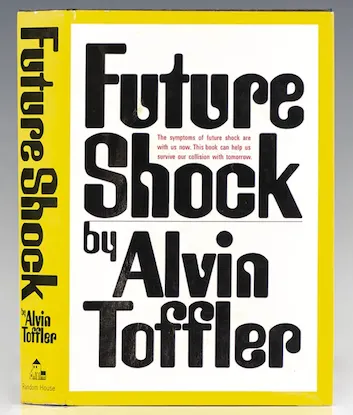
In 1970, a futurist named Alvin Toffler published Future Shock. The core argument: change is accelerating faster than human beings are built to absorb. Not just change — the rate of change. And if we don’t acknowledge that, the psychological cost will be enormous.
He was right about most of it. Information overload? Documented epidemic. Collapsing attention spans? Check. Society fragmenting into ideological sub-tribes? He called them “sub-cults” in 1970 — same thing, different vocabulary. The mental health crisis driven by relentless acceleration? He saw it coming before the internet existed.
But there was one prediction that didn’t land.
Toffler believed automation would eventually give us too much free time. That we’d work less, not more. That we’d need “leisure counsellors” — actual professionals trained to help people figure out what to do with all the hours that technology would hand back to them.
Instead, we invented doomscrolling.
| Toffler's 1970 Prediction | Accurate? | Reality in 2026 |
|---|---|---|
| Information overload will paralyze decision-making | ✓ Yes | Doomscrolling, decision fatigue, analysis paralysis — documented epidemic |
| Psychological stress from relentless change | ✓ Yes | Mental health crisis, anxiety rates at historic highs globally |
| Rise of tribal “sub-cults” around shared identities | ✓ Yes | Social media has weaponized this into political tribalism |
| Disposable society — everything temporary | ~ Mostly | Subscriptions replaced ownership; even relationships are “situationships” |
| Automation will create massive leisure time | ✗ Wrong | We work more hours, not fewer; the gig economy ate the surplus |
| “Leisure counsellors” will be a needed profession | ✗ Wrong | We got life coaches and therapists instead — to cope with overwork |
| Corporations will become fluid, project-based “adhocracies” | ✓ Yes | Gig work, contract culture, remote teams — he called it |
| Nuclear family structure will fragment | ~ Partially | Divorce rates, solo households, chosen family — directionally right |
The pattern nobody talks about
Here’s what “technology will give you your time back” has actually delivered, consistently, across every single wave:
The table doesn’t lie. Every technology that promised to free up time instead raised the expected baseline and converted the freed capacity into new obligations.
There’s a principle at work here that economists call the Jevons Paradox — identified in 1865, when a British economist named William Jevons noticed something counterintuitive about coal. When steam engines became more efficient, you’d expect coal consumption to drop. It didn’t. It went up. Because when something gets faster and cheaper, you use more of it — and keep using more of it until the new level becomes the floor.
The fax made communication faster, so we communicated vastly more. Email made messages cheaper to send, so we sent vastly more. AI is making knowledge work faster and cheaper… which means we’ll produce vastly more of it, raise the expected output standard, and arrive right back at the same workload with higher expectations attached.
Chuck wasn’t wrong that things were moving faster. He just didn’t realize that faster was the new permanent.
I know this one from the inside
In the late nineties, the internet arrived in the hotel industry with a very specific promise: hotels would finally sell direct to guests, eliminate travel agent commissions, and own the customer relationship.
I was building one of the first online hotel reservation platforms at the time. We believed that story. The whole industry did.
What the internet actually delivered was Expedia. And Booking.com. A new intermediary layer that charged hotels 15–25% commission — more than any travel agent had ever taken — and had the additional leverage of controlling the guest’s first search result. Hotels traded one dependency for a worse one. The “direct relationship” became a competitive advantage that only the biggest brands could afford to fight for, and even they didn’t always win.
The internet didn’t disintermediate the hotel business. It re-intermediated it, at scale, in a way nobody anticipated. The promise was freedom. The reality was a new landlord.
Sound familiar?
Why the AI prediction is wrong (again)
Right now, the headlines are writing themselves. Goldman Sachs: 300 million jobs at risk. McKinsey: 40% of tasks will be automated. The four-day work week is finally, actually, really coming this time.
I’d bet against the leisure part.
Not because AI isn’t genuinely transformative — it is. Not because jobs won’t be disrupted — they will be. But because the mechanism that makes “technology = free time” wrong doesn’t change just because the technology gets more powerful. It gets more powerful precisely because the technology gets more powerful.
If AI makes a lawyer three times faster, one of two things happens: her clients expect three times the work product… or she uses the speed advantage to take on three times as many clients before her competitors adapt. Either way, she’s not playing golf on Thursday afternoons. She’s ahead, but she’s still working.
And here’s the part nobody says out loud: this isn’t a failure. It’s how progress actually works. The fax machine didn’t hurt Chuck’s law practice. It changed the pace of it. He adapted, his clients got faster service, and the whole system moved forward. The discomfort was real. The disruption was real. The prediction that it would settle into leisure was the part that was wrong.
What’s actually different this time
I want to be straight about one thing, because it matters.
The transition period this time may be genuinely harder than previous waves. The fax machine displaced courier services. Email displaced the fax. Contained disruptions, absorbed over years. AI is touching writing, legal work, research, coding, accounting, medicine, and creative work — simultaneously, and fast. The breadth is unlike anything Toffler imagined in 1970.
Some people will be displaced faster than they can adapt. That’s not a talking point. That’s a real thing, and the people and communities where it happens deserve honest responses — policy, retraining, support — not just reassurance that the aggregate will sort itself out.
The aggregate will follow Chuck’s dinner table complaint, not Toffler’s leisure prediction. But “aggregate” is cold comfort if you’re in the wrong role at the wrong moment.
So what do you actually do with this?
Not panic. Not assume it’ll all work out. Something more useful than either.
Every technology wave has had a brief window — between “this is new” and “this is expected” — where early adoption was a genuine advantage. The professionals who mastered the fax before response-time expectations shifted built a real edge, even if only temporarily. The ones who waited for the pace to slow found themselves behind a standard they’d helped create without meaning to.
AI is in that window right now. And the window won’t stay open.
But here’s the part that gets missed in every “how to survive the disruption” conversation: the people and organizations that come out best aren’t the ones who use AI to produce more for themselves. They’re the ones who use it to deliver more value to others — to clients, to teams, to the industries they operate in.
| Technology | The Promise | What Actually Happened |
|---|---|---|
| Fax Machine 1980s |
Eliminate courier delays, speed up business | Compressed response expectations from days to hours. More pressure, not less |
| Email 1990s |
Replace phone tag, async communication | 24/7 availability expectations. “Quick question” culture. Inbox as a second job |
| Internet Late 1990s |
Cut out the middleman. Direct relationships. Lower costs | Created Amazon, Expedia, and an entire new intermediary layer at industrial scale |
| Smartphones 2007+ |
Flexibility. Work from anywhere | The office never left your pocket. Work followed you everywhere, always |
| Cloud / Remote Work 2010s |
True flexibility. Work on your terms | Work on every time zone’s terms. Simultaneously |
The way to succeed has always been to help others succeed. AI doesn’t change that principle. It just changes how fast you need to move to live up to it.
The professionals who’ll define this era won’t be the ones who automated their way to leisure. They’ll be the ones who used the tool to become genuinely more useful to the people around them — and who helped those people figure out what the new standard even means before someone else defined it for them.
Chuck was a sharp lawyer and a good man who saw the future more clearly than most people around that dinner table. He understood that the fax machine wasn’t just a gadget — it was a signal about how the world was about to work.
He died in January 2001, just as the next wave was cresting.
I think about that sometimes. What he would have made of email. Of the iPhone. Of a world where the brief he used to dictate to a secretary can be drafted in thirty seconds by a machine that never sleeps.
I can only imagine what he’d have said about AI.
Probably something that would have made the whole table laugh…
That was Chuck.